Shibori for Beginners: Learn Indigo Dyeing & Resist Techniques Step by Step
This introduction to shibori for beginners is designed to guide you into the fold of resist dyeing while building a foundation for long-term mastery.
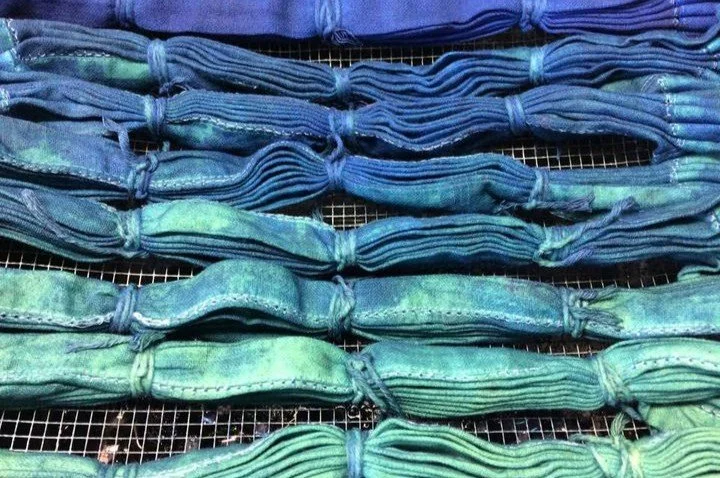
Freshly dyed shibori oxidizing before the next dip
There is a moment in Shibori when the cloth is still dry, still undecided. Before the dye. Before the reveal. This is where beginners begin—and where mastery quietly starts.
Shibori is often described as a resist-dye technique, but that definition barely scratches the surface. At its heart, Shibori is a practice of intention: folding, binding, stitching, compressing, and trusting that what you cannot fully control will become part of the beauty. For those new to the process, this can feel both exhilarating and unsettling. You follow the steps, wrap the thread, tie the knots—yet the outcome remains a mystery until the cloth is opened.
That mystery is not a flaw. It is the invitation.
Beginning with the Hands
For beginners, Shibori offers an immediate, tactile entry point. You don’t need years of experience to make something compelling. Simple folds can create striking geometry. A single bound pole can produce rippling, water-like movement. Running stitch resist—often one of the first techniques taught—introduces rhythm, repetition, and patience.
In these early stages, the hands learn before the mind does. You begin to feel how tightly to bind, how evenly to stitch, how fabric responds to pressure and dye. Each piece becomes a record of decisions made in real time.
And inevitably, there are surprises. Uneven lines. Bleeding dye. A pattern that didn’t turn out the way you imagined—but teaches you something new anyway.
From Technique to Understanding
As practice deepens, Shibori shifts. What once felt like following instructions becomes a conversation with the material. You start asking different questions:
How does fiber content change the result?
What happens when I layer techniques?
How much control do I actually want?
This is where Shibori moves from learning techniques to developing fluency. Mastery isn’t about perfection—it’s about responsiveness. Knowing when to plan carefully and when to let go. Understanding how time, pressure, and repetition shape the final cloth.
The Reveal as Teacher
Every unbinding is a lesson. The reveal—so often the most celebrated moment—becomes a form of reflection. What worked? What surprised you? What would you change next time?
For beginners, this process builds confidence. For more advanced practitioners, it builds clarity.
Shibori teaches us to work in cycles: prepare, dye, reveal, reflect, repeat. Over time, these cycles create depth—not just in pattern, but in understanding.
Leading into Mastery
Our upcoming Shibori Mastery Series is designed for those who feel that pull to go deeper. For those who have tried the basics and are ready to slow down, refine their approach, and explore Shibori as a sustained practice rather than a single project.
In the mastery series, we’ll focus on:
Expanding traditional techniques with intention
Reading cloth and anticipating outcomes
Combining methods for layered, complex surfaces
Developing a personal Shibori language
This is not about moving fast. It’s about moving with awareness.
An Open Door
Whether you are just beginning—curious, tentative, excited—or standing at the edge of deeper commitment, Shibori meets you where you are. Each fold is a starting point. Each stitch, a quiet step toward mastery.
The cloth remembers everything you do to it. And over time, so do your hands.
We invite you to begin—and to continue.