Layers of Cloth, Color and Meaning
The Aizome Shibori Signature Series
A piece of hand-dyed cloth is never only about color.
Within its folds are decisions: where the fabric was stitched, how tightly the thread was pulled, how the cloth was compressed, how long it rested in the vat, and how many times it was returned to the indigo. Every line and variation holds evidence of the maker’s hand.
Shibori is often introduced as a collection of beautiful patterns, but its deeper lesson is about process. It teaches us to understand the relationship between cloth, pressure, resistance, dye penetration, oxidation, repetition, and time.
That understanding is at the heart of the Aizome Shibori Signature Series.
Learning Through Progression
The Signature Series was created as a sequence of focused workshops, with each experience building upon the one before it. Rather than rushing through a long list of techniques, participants are given time to examine why a pattern develops and how small changes in preparation affect the finished cloth.
A stitch placed a fraction of an inch differently can change the movement of a line. Increased thread tension can create a sharper resist. A tightly compressed fold may prevent dye from entering the deepest layers, while a looser fold allows blue to travel farther into the cloth.
These discoveries cannot be fully understood by looking at a finished sample. They are learned through making, observing, adjusting, and repeating.
The workshops bring together traditional Japanese textile processes and tools, thoughtfully adapted for today’s teaching environments. Participants work in small groups, allowing space for individual guidance, careful preparation, and meaningful conversation about the cloth as it develops.
Foundations
The journey begins with the essential language of shibori.
In Foundations, participants explore how folding, binding, stitching, and compression create resist. The emphasis is not simply on producing a collection of samples, but on beginning to recognize cause and effect.
Why did the dye reach one area but not another?
What happens when the thread is pulled more tightly?
How does fabric weight influence the clarity of a pattern?
What changes when a piece is dipped again?
These early lessons become the vocabulary for everything that follows.
Precision & Repetition
Repetition is one of the quiet strengths of Japanese textile design.
In Precision & Repetition, a single action—one fold, one stitch, one wrapped point—is repeated across the cloth. Through repetition, the maker begins to understand rhythm, spacing, alignment, and consistency.
The goal is not mechanical perfection. Handmade cloth should retain the character of the hand. Precision provides structure, while subtle variations create movement and life.
This workshop encourages participants to slow down, plan carefully, and see how a repeated gesture can become an expansive pattern.
Stitch Resist Intensive
Stitched shibori asks us to think beneath the surface.
The lines drawn on the cloth are only the beginning. The final pattern is shaped by where the fabric gathers, how the folds stack together, and how firmly the threads are secured.
During the Stitch Resist Intensive, participants explore the relationship between stitch placement, compression, thread tension, and dye penetration. Traditional patterns provide a framework, but the greater lesson is learning to anticipate how the cloth will transform when it is gathered.
The stitched cloth becomes almost sculptural before it enters the vat. Only after dyeing, oxidation, rinsing, and removing the threads is the full design revealed.
That moment of opening is one of shibori’s enduring pleasures.
Layering & Complexity
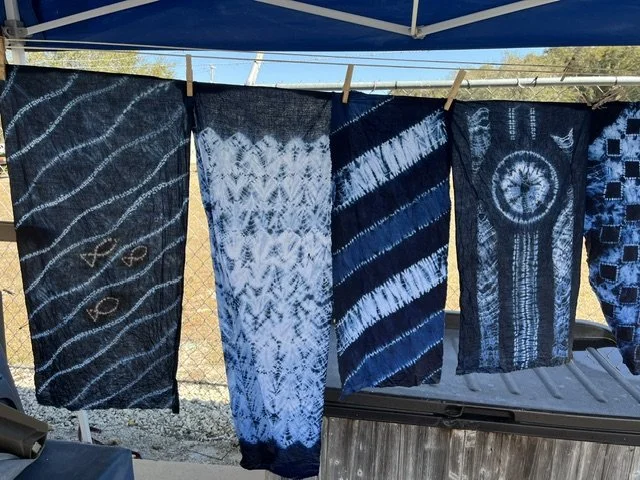
Complex cloth is rarely created in a single step.
In Layering & Complexity, participants begin combining processes. A stitched pattern may intersect with a fold. One resist may be dyed, opened, repositioned, and dyed again. A second layer may deepen the color, interrupt the first design, or introduce an entirely new rhythm.
Layering requires both planning and a willingness to respond to what the cloth reveals.
Each stage leaves a record. Pale blue remembers the first dip. Deep indigo marks the areas that remained exposed through repeated dyeing. White lines preserve the places that resisted every layer.
The result is cloth with visual depth—a surface that invites the eye to move closer and discover how it was made.
Mastery
Mastery does not mean that every result is predictable.
It means understanding the process well enough to make informed choices while remaining open to discovery.
The Mastery workshop brings together the lessons of the series: thoughtful design, controlled stitching, purposeful compression, layered resist, repeated indigo dyeing, and careful finishing. Participants begin moving beyond individual techniques to develop a more personal language in cloth.
The patterns taught in the Signature Series include traditional methods and specialized processes that are not commonly included in introductory shibori workshops. Many were learned through immersive study in Japan and are taught using traditional tools and materials whenever possible.
But the most important outcome is not the number of patterns completed.
It is the ability to look at a piece of cloth and understand how to move from an idea to a process—and from a process to a meaningful finished textile.
Blue Builds Slowly
Indigo rewards patience.
The cloth enters the vat and emerges yellow-green. As it meets the air, it begins to shift. Green becomes turquoise, turquoise becomes blue, and repeated dips gradually deepen the color.
The process cannot be hurried. Each layer must oxidize before the next can be built.
In many ways, the Signature Series follows the same rhythm. Skill develops through repeated practice. Understanding grows from one workshop to the next. Confidence comes not from eliminating uncertainty, but from learning how to work with it.
Layer by layer, the cloth changes.
So does the maker.
The Aizome Shibori Signature Series is designed for those who want to move beyond a single introduction to shibori and develop a deeper understanding of traditional process, pattern, and indigo. Each workshop may be taken as an individual experience, while the full progression offers a pathway toward increasingly complex and personal work.
Come prepared to stitch, fold, bind, dip, observe, and discover what is waiting within the cloth.
A Special Winter Opportunity: The Complete Journey
For those who want to experience the full progression of the Signature Series, the Shibori Mastery: Cloth, Process & Indigo Winter Retreat offers a rare opportunity to move through every stage within one immersive experience.
Rather than learning techniques in isolation, participants will begin with foundational resist methods and gradually progress through precision, stitched shibori, repetition, layering, and increasingly complex pattern development. Each new process will build upon the lessons of the previous one, allowing participants to see how stitch placement, thread tension, folding, compression, dye penetration, oxidation, and repetition work together.
The extended retreat format gives us something especially valuable: time.
There is time to prepare cloth carefully, to dye in multiple layers, to open and study the results, and then to apply what we have learned to the next piece. Participants can repeat a process with greater intention, make adjustments, and watch their understanding develop alongside the depth of the blue.
Working with a Sukumo Indigo Vat
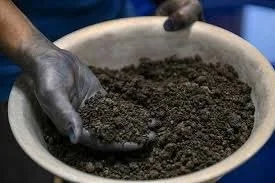
Fresh Sukumo Indigo before preparing vat
At the heart of this retreat will be a traditionally maintained sukumo indigo fermentation vat.
Sukumo is produced from Japanese indigo leaves that have been harvested, dried, moistened, turned, and fermented over an extended period. Its production requires specialized knowledge, close observation, and careful management before the material is ever used to establish a dye vat.
Unlike a natural or pre-reduced indigo vat that can be prepared relatively quickly, a sukumo vat is a living system. Through fermentation and the activity of microorganisms, insoluble indigo is transformed into a soluble form that can enter the fibers. When the cloth is removed and exposed to air, oxidation returns the pigment to its familiar blue.
The vat must be watched, fed, rested, stirred, warmed, and understood. Its condition can shift from day to day, and the dyer learns to respond to its aroma, surface, temperature, color, and behavior.
This relationship between dyer and vat is one of the reasons working with sukumo is so special.
Participants will not simply dip cloth into blue dye. They will experience the rhythm of working with a traditional fermentation vat over a period of days—learning when it is ready, how gently the cloth must be introduced, why oxidation between dips matters, and how color is gradually built rather than applied all at once.
Because establishing and maintaining a sukumo vat requires significant time, skill, materials, and daily care, opportunities to work with one in an extended teaching environment are uncommon. This retreat allows participants to experience indigo not merely as a color, but as an ongoing practice rooted in agriculture, fermentation, observation, and stewardship.
One Vat, Many Layers of Learning
Working from the same vat throughout the retreat also creates continuity.
Participants will be able to compare how different fabrics and resist structures accept the dye. They will see how a tightly stitched line behaves differently from a wrapped point, how deeply indigo travels into folded cloth, and how repeated dipping changes both color and pattern.
The progression becomes visible:
A first dip establishes the beginning.
Repeated dips build depth.
Opening the resist reveals what the dye could not reach.
Studying the cloth informs the next decision.
By moving through the complete Signature Series in this concentrated format, participants can begin with individual techniques and finish by bringing several processes together in more personal, layered work.
The winter retreat is intended for those who want more than a collection of beautiful samples. It is an opportunity to understand the relationships beneath the patterns, experience the responsibilities and rewards of a living sukumo vat, and develop a more thoughtful language in cloth.
Layer by layer, the blue deepens.
Process by process, understanding grows.
And over the course of the retreat, the maker begins to see shibori not simply as a technique, but as a continuing practice of observation, patience, intention, and discovery.
Your Invitation to Go Deeper
Whether you are beginning your exploration of shibori or ready to develop a more complex and personal practice, the Aizome Shibori Signature Series offers a place to begin—and a pathway to continue.
You may choose an individual workshop that speaks to your interests, or follow the full progression from Foundations through Precision, Stitch Resist, Layering, and Mastery.
For those seeking the most immersive experience, the winter Shibori Mastery: Cloth, Process & Indigo Retreat offers the rare opportunity to move through the complete series while working over multiple days with a traditional sukumo indigo fermentation vat.
This is more than a chance to make beautiful cloth.
It is an invitation to slow down, observe closely, understand the process beneath the pattern, and allow your own visual language to emerge.
Come ready to stitch, fold, bind, gather, dip, oxidize, open, study, and begin again.
Explore the Aizome Shibori Signature Series
Indigo, Shibori & Katazome Workshops — Aya Fiber Studio→
Experience the Complete Winter Retreat January 18-28, 2026 LIMITED SEATING!
Shibori Mastery: Cloth, Process & Indigo Retreat — Aya Fiber Studio→
Space is limited to preserve the small-group, hands-on nature of the experience.