Indigo: The Blue That Helped Build a Nation
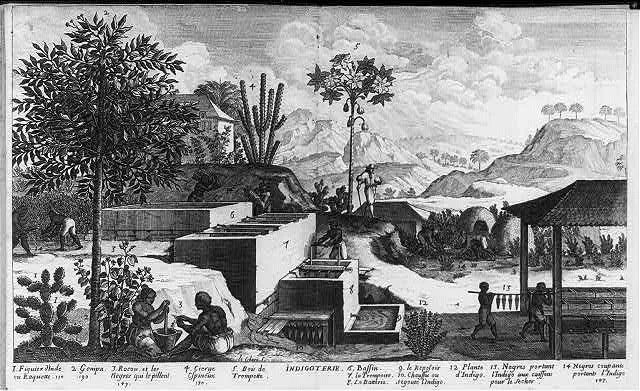
This drawing depicts a plantation in the West Indies it provides an example of the system of three vats that was used to produce indigo dye.
As we celebrate Independence Day, our thoughts naturally turn to the American flag. But long before synthetic dyes existed, the colors of the flag—and countless textiles throughout the colonies—came from the natural world.
The deep blues of the eighteenth century were most often created with indigo, a remarkable plant that shaped economies, influenced international trade, and became woven into the story of early America.
More Than a Dye
Today, indigo is cherished by textile artists for its rich color and centuries-old traditions. In colonial America, however, it was also a valuable agricultural crop.
By the years leading up to the American Revolution, indigo had become one of the most important exports from Britain's mainland American colonies, ranking behind only tobacco and rice in export value. Most of it was grown in South Carolina and Georgia, where the warm climate proved ideal for cultivation.
The success of the crop is closely associated with Eliza Lucas Pinckney, whose experiments in the 1740s helped establish indigo as a profitable colonial industry. Her work transformed indigo from a promising plant into an export that supported farmers, merchants, and the growing colonial economy.
The Color of Independence
When the American Revolution began, textiles became more than everyday necessities.
Many colonists chose to spin, weave, and sew their own cloth rather than purchase imported British textiles. Community "spinning bees" became symbols of patriotism, with families proudly wearing homespun fabrics as an expression of independence and self-reliance.
The earliest American flags were created before synthetic dyes existed. Blue fabrics of the period were commonly dyed with indigo, while red fabrics were often colored with natural dyes such as madder root or cochineal. Although historians cannot identify the exact dyes used in every early flag, these were the principal sources of color available to textile makers of the time.
Every flag represented the work of many hands—those who grew fibers, spun yarn, wove cloth, prepared natural dyes, and stitched each piece together.
Benjamin Franklin and the Value of American Trade
During the Revolutionary War, Benjamin Franklin served as one of the United States' commissioners in France, where he worked tirelessly to secure diplomatic recognition, financial support, and trade agreements for the young nation.
Franklin understood that America's future depended not only on military victories but also on demonstrating that the new nation possessed valuable resources and a productive economy. Colonial exports—including indigo, tobacco, rice, timber, and naval stores—helped show European allies that America had goods worth trading.
While Franklin was not an indigo merchant, the success of export crops like indigo strengthened the economic foundation that helped the United States gain international support during its fight for independence.
A Living Tradition
Every time I lower cloth into an indigo vat, I'm reminded that this beautiful blue carries centuries of history.
Indigo has colored ceremonial garments in Japan, work clothing throughout Asia, treasured quilts in America, and textiles across nearly every continent. It has crossed oceans, connected cultures, and supported livelihoods for generations.
For those of us who continue to practice traditional dyeing today, indigo is more than a color. It is a living link to history—a reminder that cloth has always been more than something we wear. It tells the story of agriculture, science, craftsmanship, trade, resilience, and community.
This Fourth of July, as you see the Stars and Stripes waving overhead, take a moment to appreciate not only what the flag represents, but also the remarkable natural materials and skilled artisans whose work brought those colors to life.
History isn't only written in books.
Sometimes, it's woven into cloth.
#Indigo
#Natural Dyes
#American History
#Colonial America
#Textile History
#Fiber Arts
#Indigo Dye
#Eliza Lucas Pinckney
#Benjamin Franklin
#Fourth of July
#American Flag
#Colonial Textiles
#Slow Craft
#Heritage Crafts
#Traditional Textiles
#Handcrafted Textiles
#Sustainable Textiles
#Shibori
#Aizome
#Aya Fiber Studio